Thursday, August 27, 2009

Boldly seek, Boldly find


Boldness of thinking is tied to critical thinking. This is why men tend to be more analytical.

I know that I speak with the bias of a man. If you are a female reader, please don't let your bias keep you from seeing things are they are. I promise to try and do the same, starting by exposing the weaknesses of the analytical mind.

Oscar Wilde wrote that a cynic understands the cost of everything and the value of nothing. Analytical people are often cynics. In a purely analytical world, we have the world of Star Trek's Spock, a cold world where things are understood, but not enjoyed. Everything is in a box, but nothing is in our hearts.

The analytical mind can understand, discover and build things. But it takes the visceral/experiential mind (i.e. the heart) to enjoy them.

The heart is our safe place. It is the place we can call home. But don't get too comfortable with that snake in the bed, or those termites eating at your home's foundation. The rhythm of that dripping faucet isn't meant to provide the same comfort as the rhythm of a mother's heart. A person who is lead by their emotions and throws out their mind is blind. Having no discernment and lacking the boldness to ask questions, they have no answers and inevitably fall into a ditch.

There is value in the yin and the yang, the analytical and the visceral, the male and the female.

It is with my mind that I can ask questions and it is with my heart that I can receive their answers no matter what they may be.

Prepare your mind by boldly asking and prepare your heart by boldly receiving.

Thursday, August 20, 2009

The Silence of God


Let's face it, if God exists, He is silent.

What makes us question better than a mystery?

And what brings an answer better than a question?

And what allows us to think about those answers better than silence?

God's silence asks us to question, telling us a mystery and whispers the questions that are more important than the answers.

Tuesday, August 18, 2009

Bold Thinking


Truth requires bold thinking.

How many times have you, or someone you have observed, failed to learn a software program (or computers in general) because it appeared to be too complex? Does it not take a boldness of thinking to ignore such perceptions and to trod on?

As a musician, if I tell someone that a chord is a G7#5b9, the name itself can intimidate many musicians. I've met musicians and songwriters who claim to want to get better at their crafts, but as soon as they hear concepts expressed that sound complex, their tendency is to ignore or downplay them.

But isn't anything that is difficult or complex, merely a concatenation of a bunch of simpler things? When you break down computer codes to their simplest forms, they are merely 1's and 0's.

I'm not in love with the imagery of this aphorism, but it has been said that the way a snake swallows a pig is one inch at a time. I've found that nothing is so complex that it can't be broken down into simpler elements. It takes boldness to do the breakdowns. It takes questioning to make the complex understandable.

Complexity is an illusion. The illusion is shattered by breaking things down. The questioning process breaks the complex down into the "bite sized chunks" we need. Have the boldness to question and a bias towards truth and nothing less. Be willing to surrender all that you believe if the process threatens it. Have the boldness to be willing to surrender it all.

Saturday, August 8, 2009

Coexist. An Imposed Delusion


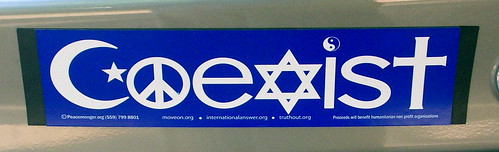
I see cars with the above bumper sticker all the time. I believe in peaceful coexistence and totally agree with the idea that religions should not let disagreements turn into violence. While the thoughts behind the bumper sticker are well-intentioned, I think some of them are also shallow and disrespectful of the distinct qualities of religion.

First of all, it is as if the person with the bumper sticker thinks that all they have to do is tell religious people to coexist and wha-la, peace will magically happen. And no wonder they believe this. Most people seem to believe that religion is nothing more than a self-imposed delusion meant to help people get through life, feel better about themselves and provide guidance. They see religion as something that serves the religious.

But what the bumper sticker misses is that many religious adherents actually believe their faith conforms to reality. We actually believe that it is TRUE. Imagine that!

There is a funny thing about truth. You can't pick and choose it. Have you ever noticed how the world is probably nothing like you would have designed it? In my foolish logical mind, if I could have designed the world, it would be so utilitarian as to have nothing but 90 degree angles, human beings would have wheels instead of being legs to walk, and the cosmos would not exist in its vast emptiness. The Earth would be flat but never ending and there would be no other planets or worlds beyond it. People wouldn't differ in heights, abilities, or privileges of any kind. I don't think I would have had the creativity or the wisdom to have created beauty, not seeing any practical value in such a thing....

Doesn't this alien world we live in scream "You don't get to choose truth"? Our very genetics reverberate this sentiment.

Then why do we think that when it comes to religion, things are different?

The reason that I'm a Christian is because I have found no better explanation of its stories than the one that says, "they must be true". Believe me, I've tried thinking that it was made up by the authors of the Bible, or by the church, or that Jesus was merely a man who has been mythologized over time, etc.... Every alternative that I've considered took MORE faith than simply believing as a Christian.

I believe Christianity is true, NOT simply MY truth. For instance, when Christianity says that humanity has a fallen nature, I believe that applies to everyone, even non-christians!

The fall of man (and creation itself) might not be absolutely proven, but it still can be tested. I've found no test that disqualifies it but no smoking gun to absolutely prove it 100% without a doubt either. The greatest proof I've found of this and other Christian truths is simply that by living my life as if these claims are true, I have found the best way to live. One popular Christian teacher (Steve Brown of www.stevebrownetc.com) says that Christians are beggars who having found bread, are simply pointing the way for others to do the same.

Good religious people can disagree and argue their points. Not only would I say that the debate needs to continue, but we don't do enough debate. Critical thinking should prevail. We don't talk enough about religion, treating it as a taboo subject. But how can a system of belief that addresses the most fundamental questions of life, such as what is its very purpose and what happens after death, be ignored? Isn't that the height of insanity?

As a Christian, I reject reincarnation. I can't prove that this is the only time we go around any more than the Hindu or Buddhist can prove reincarnation. But I can demonstrate how the Christian belief in only one life on earth causes one's life to be better for it.

I sense that "coexist" means "live and let live" by not even debating or discussing our differences. I see it as affirming relativism when it comes to matters of faith. I have to reject such an affirmation. And anyone proponent who expresses disagreement with me, is certainly no relativist. How can someone who believes all truth is relative and one's perception is truth argue with someone else's perception?

I believe in the dialectics of Hegel. It says that truth is to be found by forming a thesis, an antithesis and a synthesis. In other words, you start with a belief, you test that belief against its opposite and you let that testing process flesh out what is and isn't true until you find the truth.

If your faith is true, it can not be threatened by debate. If it is false, why would you want to nurture and protect it from debate?

Finally, I want to say that the best thing that a "coexist" proponent can do to encourage peace among religious people is to encourage Christians to follow Christ. By truly following Christ, there is no room for imposing my faith through coercion or violence. The same is true of many other religions. Unfortunately, I can't say this is true of every religion....

Thursday, June 18, 2009

Does everything have to have a beginning?


Pascal once wrote that belief in God is incomprehensible and disbelief in God is inconceivable.

The same can be said about the infinite/eternal, but I think of it in different wording. Imagining something or someone to not have a beginning is difficult to comprehend, but not as difficult to imagine.

Imagining something to not have a beginning or end, might be difficult because of our finite point of reference. Everything we humans observe in this world has a beginning, even the universe (see below). However just because everything we know has a beginning doesn't mean that everything HAS to have one.

Science has confirmed that the universe has a beginning. The logic goes that because of the doppler effect found in cosmic background radiation, we know that space is expanding. If space is expanding, then it must had a starting expansion point.

Science has also confirmed that the universe has an end. Our telescopes find dying stars all the time. Our sun has a very definite lifespan. When the sun goes, life on earth as we know it will cease as well.

This confirmation of the finiteness of the known universe begs the question: "What caused it all?" After all, if the universe were eternal, such a question wouldn't be necessary. But we know that finite things have causes/sources.

I only know of two possibilities. Either an eternal process caused it, or an eternal being.

Belief in an eternal being is a simpler explanation than belief in an eternal process. After all, belief in an eternal being also explains the order found in the universe. Order always comes from intelligence. No exceptions have ever been found.

Something else that Pascal observes is that God has revealed Himself with enough clues in creation to know of His existence, but He also hides Himself enough so that we may sense our unworthiness of Him.

If Creation testifies of this, then this begs the question: What can save us from this condition?

Tuesday, June 16, 2009

Faith and Creativity


Have you ever noticed the lack of creativity within the Christian church? Just look at how the average church names itself. Often, they are named after the street name or town/city where they are located.

And I can't tell you how many creative types say that the church has NOT made a home for them. Creative people "think outside the box" and this often makes religious people feel uncomfortable. No wonder the church has a reputation of being boring.

Everything is often so predictable. Even churches that put on a show by adding productional elements, are still so predictable, formulaic and often unimaginative. And please don't get me started on the creativity drought found in Contemporary Christian music.

Why do I suggest that people of faith should value creativity? Is it simply because of my personal bias as a creative type or is there a deeper reason?

Like creativity, doesn't faith require us to use our imaginations and to visualize? A creative sculptor has to visualize what they want to sculpt as they create their art. A musician has to exercise great imagination to create music. When faith tells us that there is a God, a heaven, a hell, does it not require us to do the same?

Secondly, and perhaps a foreign concept to many of us, what is faith if it doesn't challenge us to critical thinking, just like creativity does? No wonder this is a foreign concept. People of faith aren't exactly known for critical thinking. I left a particular Christian denomination years ago because I found that they inherently rejected critical thinking and couldn't provide answers to my questions.

I've watched the church view critical thinking as a threat to core doctrine. But I have always believed that if a doctrine is true, than it can survive all critical thinking as long as our we are objective. I instinctively believe that the truth will withstand all assaults if we are open to it. I don't deny my biases and can't eliminate them, but do everything that I can to minimize them.

Perhaps some of you don't see the connection between critical thinking and creativity. This is best seen via illustration. I teach guitar as an adjunct professor and private instructor. When I give my students a scale, I ask them to question it. I challenge them to ask, "What can possibly be done with this set of notes?" The result of such critical thinking is that they will try ordering the notes of a scale in creative ways that yield all sorts of melodies, phrases and patterns. They end up coming up with things that are new. So, while it is not often said, creativity is directly tied to critical thinking.

A simpler example, that non-musicians can better appreciate, is to take the game of Scrabble. Each player is given seven letters. Success requires the player to question the letters they possess asking, "What words can be formed??" This type of critical thinking will yield the fruits of creativity.

Another reason that everyone, whether religious or not, should value creativity is simply because creativity allows for repetition. I can endure, and even enjoy repetition, if it is done with creativity. I need to remind myself of truths that I have known for years, but if those truths aren't presented to me with the freshness that creativity provides, I'm not going to be able to receive them. A church that can't present old truth creatively, will be challenged to endure boring repetitions and grow stale with traditionalism. The only alternative is for it to find "new truth", which is not exactly an inherent quality within religious faith, and is a back door to heretical teaching.

Something else that is interesting about creativity, is its connection to propositions and systems. In the above two examples, creativity has to be applied to propositions (think black and white). I ask the musician to apply creativity to a scale, which is born out of the system of music theory. The Scrabble player applies creativity to letters to form words.

Christianity echos this truth when it says:

"Faith comes by hearing and hearing by the Word of God." Romans 10:17

"The word became flesh and made his dwelling among us." John 1:14

Computers are even examples of this connection. The fruits of digital creativity are found in Youtube, Itunes, MySpace, and even at a more rudimentary level in the graphics of the operating system (GUI for you computer geeks). Yet, all of it boils down to the binary propositions of 0's and 1's (black and white, right and wrong).

So I'm not simply advocating that people of faith should make things up. The creativity that is faith is hinged to the propositions that we commonly call theology and Divine revelation.

So given all of the above, why is it that people of faith so often lack creativity and imagination? I would expect people of faith to have the most profound imaginations. Could this be the consequence of centuries of institutional religion that has produced a top down hierarchy of compliance as opposed to the critical thinking process of considering other's perspectives via the dynamics of a true community?

Have you ever noticed how often Jesus engaged people with questions?

Monday, June 1, 2009

Faith Balances the Extremes


Faith is belief in moderation, the opposite of extremes, the antithesis of the "one-ended stick".

It is obvious that faith can't exist without belief. Whenever Jesus encountered someone who struggled with belief, He would commonly ask, "Where is your faith"?

But notice that He also never asked, "Where is your certainty?"

Just as faith is impossible without belief, it is equally impossible without the presence of doubt.

If you are absolutely 100% certain of any belief, it can NOT be defined as faith. No one has FAITH that they are going to die. No one has faith that the sun will come up tomorrow (although it IS possible, but extremely unlikely that it will NOT come up).

If faith is a belief that is the mean between doubt and certainty, than it appears to in the middle between two extremes.

So why is it that people of faith so often find themselves at the fringes of life?

If you do NOT have faith, then what are you left with except to believe only in that which can be proven with certainty (which is very little) or with a perpetual skepticism that leaves your mind unhinged.

"Let beliefs fade fast and frequently, if you wish institutions to remain the same. The more the life of the mind is unhinged, the more the machinery of matter will be left to itself." - G.K. Chesterton, Orthodoxy, pg 60.

Such thinking changes nothing, not even its adherent.

I once heard a local pastor say it this way: "If your faith hasn't changed you, then you need to change your faith."