Reason, isn't so much a truth detector, but a potential falsehood detector. I say *potential*, because a falsehood may be reasonable under certain presuppositions.
You might ask, why can't we measure those presuppositions with reason? Many times you can, but there is a depth beyond reason's reach. This depth, reaches into the metaphysical. A paradigm is very difficult to evaluate if it is built upon metaphysical presuppositions. Sure, you can use reason to determine whether the paradigm is consistent, but you can't validate metaphysical presuppositions with certainty.
Let me give an example. It is probably too simplistic but generally, you can say that there are at least two assumptions that one can build a worldview upon. One says that man's most natural inclination is to do good, while the other says his natural inclination is to do evil.
A worldview built upon the former says that crime and socially malevolent behavior are caused by environmental and sociological factors. This worldview therefore emphasizes rehabilitation over punishment.
A worldview built upon the latter says that crime and socially malevolent behavior are natural to man. He therefore needs a deterrent and incentive system (the popular focus incorrectly tends to be more on deterring then incenting in my view) to 'do the right thing'.
How does one test which view on man's nature is correct? Although I do believe that induction and deduction can be used to give credibility to one over the other (as a Christian, I believe in man's sin nature), ultimately these two assumptions are metaphysical in nature because they can not ultimately be proven via a 'smoking gun' litmus test.
Unfortunately, we can't avoid building paradigms upon metaphysical presuppositions. And by metaphysical, I don't simply mean "religious", I am referring to any belief that is beyond empiricism's reach.
So how do we choose a paradigm when our only choices are metaphysical? Metaphysical choices require nothing less than faith.
Faith is volitional. In other words, we believe what we want to believe.
So why are left in such a predicament? Why are the answers to life's ultimate and most important questions left to the subjectivity of our volition instead of the meticulous scrutiny of empiricism? It seems that there is something in life that
is testing our hearts more than our minds. And since things can't ask questions, that "thing" is a being...
At the center of the universe is a giant heart...
Human nature tends to swing from one extreme to another, like a pendulum... The Pendulum Effect is a blog by Greg Jones, that attempts to go deeper into the philosophical presuppositions of life. Summed up by the mantra "Ask why until you get to who", Greg Jones shows us the profound nexus between faith and reality.
Showing posts with label Faith. Show all posts
Sunday, October 30, 2011
Thursday, September 30, 2010
Truth Without A Christ Context
LeRon Shults, former professor of theology at Bethel Theological Seminary, wrote:
From a theological perspective, this fixation with propositions can easily lead to the attempt to use the finite tool of language on an absolute Presence that transcends and embraces all finite reality. Languages are culturally constructed symbol systems that enable humans to communicate by designating one finite reality in distinction from another. The truly infinite God of Christian faith is beyond all our linguistic grasping, as all the great theologians from Irenaeus to Calvin have insisted, and so the struggle to capture God in our finite propositional structures is nothing short of linguistic idolatry.
This is a fantastic thought but woefully incomplete. This is truth without the context of Christ. Yes, Christianity (and all the major monotheistic religions) confirm that God is infinite and beyond description. However, if an infinite God wants to communicate to a finite being, He will limit Himself in that revelation.
When a parent speaks to a child, do they use their "native" adult language? Maybe that parent holds a doctorate degree. Do they use high-brow academic language when speaking to their toddler? Aren’t family physicians taught to limit their technical jargon when communicating to their patients?
Christianity says that the infinite God has revealed Himself in a finite way. This is profound when you consider that this finite way was in the physical form of Jesus Christ.
Christ is the ultimate set of propositions. The Scriptures literally call Him “The Word”. The very statement “There are no absolutes.” is an absolute statement.
With the above said, let me also write against the other extreme. God cannot and should not be reduced only to a set of propositions. The scriptures describe this “Word” as living, walking, breathing, talking, dying and resurrecting. He healed the sick, gave sight to the blind and loved all. Unlike other gods who claim to love us, He proved it by giving His life, something your average god can’t do.
BTW, this answers the age-old philosophical question, “Can God create a rock that He can’t lift?” Yes He can and He did. He is infinite so He CAN limit Himself. He HAS limited Himself so that we can know Him. We cannot know the infinite. This doesn't mean He is limited in ability, only in presentation to us.
In other words this God who is infinite in ability, has limited His will. The Godliest thing we can do is to do the same. THIS is why belief in the Christian God is tied to morality, character and integrity.
But people that reduce God to just black and white, tend to be dogmatic out of what appears to me to be a sense of insecurity. I think they are insecure with NOT knowing. This is antithetical to the idea of faith.
Faith is a moderation of belief. It is to believe something enough to not be a persistent, consistent skeptic but to doubt it enough to not be dogmatic. Anything else is extremism of belief. At least that’s what I believe, but I can’t be for sure.
Labels:
certainty,
context,
doubt,
Faith,
limitations,
moderation,
rock
Tuesday, June 8, 2010
Exploring Boundaries: Faith & Reason
I believe in the integration of faith and reason. Even many of my Christian brothers & sisters disagree with me here, I am not alone. Pascal, Edmund Burke, Augustine, Chesterton, C.S. Lewis, Ravi Zacharias and many many others would echo this affirmation.
When we put on seatbelts to ride in a car, we do so because logic says that the seatbelts make us safer. However because we cannot absolutely know whether or not we will arrive at our destination safely, our decision to ride in the car is based upon faith. Furthermore, if the driver of the car was inebriated, reason would dictate that such faith would be even less founded, if not unfounded.
I believe in Christ but not without reason. But because my reasons can not absolutely prove Him to be true, I still have faith. There is a reason that the Bible says that the Christ who could walk through walls in his resurrected body rolled away the stone from His tomb. It wasn't so that He could get out. It was so that we could see in.
I have blogged on the reasons for my faith in other posts and will not reiterate them again. But now that I have established this nexus of reason and faith, let's explore their limitations.
The limitations of reason are less obvious to many. Maybe you've read about the philosopher who asks questions like "How do I know I exist?" and "How do I know that I'm not really asleep living in a dream?" Go without food and drink for a while and you'll know that you are alive even if you can't explain how or why via reason. We somehow know that we exist but we can't explain how.
The limitations of faith are obvious. I can have faith that the world is flat, that I am the king of Narnia, that I am going to be healthy, wealthy, famous and wise, but reality does not always conform to our faith.
I can have faith that the oil currently spewing into the gulf of Mexico will miraculously stop but I cannot presume my faith upon God's will. It is only when I know the will of God that my faith can have traction.
What is at the boundary of reason if it is not faith? And what is at the boundary of faith if it is not God?
Thursday, September 17, 2009
Faith Directions: To have faith, believe here.
I have made the case for faith in "The World Screams Faith" as well as other blogs. But this just begs the question, "What shall I have faith in?"
This world that screams faith, imposes faith decisions on us every day. Whenever we get into a car to drive to a destination, do we absolutely know with 100% certainty that we will arrive at our destination safely? I just passed a fatal car accident yesterday where thd driver's van was turned upside down.
Like that driver, we cannot absolutely KNOW anything, much less whether or not we will arrive safely at a destination. Now, would you get in the passenger seat of a car, put your seat belt on and let a totally inebriated driver take the wheel for the next 30 minutes on a busy interstate?
What's the difference between these two scenarios? Is it not found in the probability of you reaching your destination safely? Is it not found in the amount of reasoning you are able to apply given each scenario? Since theoretically your fate could swing either way, your choice is based ultimately on faith.
I advocate a rational faith. A faith that takes in the facts and boldly asks all the possible questions, willing to go wherever those questions might lead.
Someone has said that capitalism is the worst economic system in the world except when compared to all other economic systems in the world.
It is a fantastic leap of faith for me to believe in all that Christianity stands for, but it is a ludicrous leap of faith for me to reject it.
I believe in the testimony of the 40 authors who wrote the 66 books of the Bible, spanning over 1000's of years and crossing many cultural boundaries. I don't hold this faith because I can prove it. I hold this fantastic faith because rejecting it is impossible when considering the facts.
Skeptics who claim that its claims are fictious fail to give an alternative explanation that requires less faith than the Christian faith to which I hold.
The strongest and most common criticism they levy is the claim that the New Testament (N.T.) was written by people in high powers of Government throughout history in order to control the masses, gaining money and power through belief.
We believers stand in awe of common themes that exist between the O.T. and N.T.
My favorite one is to simply compare John 3:16 with Genesis 22:
John 3:16, the most famous verse in the Bible, says, "For God so loved the world, that He gave His only son so that whoever believes in Him will have eternal life."
This scripture is a one verse summary not only of the Gospels as they unfold their story in the N.T., but also of the O.T. story of Abraham offering His only son Isaac as a sacrifice in Genesis 22.
But the skeptic believes this coherence was manufactured. They believe that the four Gospel writers collaborated and wrote their accounts to purposefully mirror the O.T.
These same skeptics will point out the differences in various Gospel accounts. Yet, if the four Gospels are the result of a collaborative scheme, why would the authors give varying accounts of some stories? Why would they disagree on some details?
And none of this explains the motives and veracity of the O.T.
A plausible alternative explanation has not been offered by the skeptic. It takes great faith to accept Christianity, and a greater faith to reject it.
Given the volitional nature of faith established in previous blog postings in the Pendulum Effect, life (or as I believe God) asks us the question, "What do you WANT to believe?" Such a question tests our heart's desire and tells us what WE are, not what this world is. The telescope that we try to aim outwardly, has turned inward becoming a microscope. What starts out as an attempt to search outer space, becomes a discovery of "inner space".
What were you made for? Does your heart scream "ME, ME, ME!", or does is beg to serve someone greater?
Tuesday, June 16, 2009
Faith and Creativity
Have you ever noticed the lack of creativity within the Christian church? Just look at how the average church names itself. Often, they are named after the street name or town/city where they are located.
And I can't tell you how many creative types say that the church has NOT made a home for them. Creative people "think outside the box" and this often makes religious people feel uncomfortable. No wonder the church has a reputation of being boring.
Everything is often so predictable. Even churches that put on a show by adding productional elements, are still so predictable, formulaic and often unimaginative. And please don't get me started on the creativity drought found in Contemporary Christian music.
Why do I suggest that people of faith should value creativity? Is it simply because of my personal bias as a creative type or is there a deeper reason?
Like creativity, doesn't faith require us to use our imaginations and to visualize? A creative sculptor has to visualize what they want to sculpt as they create their art. A musician has to exercise great imagination to create music. When faith tells us that there is a God, a heaven, a hell, does it not require us to do the same?
Secondly, and perhaps a foreign concept to many of us, what is faith if it doesn't challenge us to critical thinking, just like creativity does? No wonder this is a foreign concept. People of faith aren't exactly known for critical thinking. I left a particular Christian denomination years ago because I found that they inherently rejected critical thinking and couldn't provide answers to my questions.
I've watched the church view critical thinking as a threat to core doctrine. But I have always believed that if a doctrine is true, than it can survive all critical thinking as long as our we are objective. I instinctively believe that the truth will withstand all assaults if we are open to it. I don't deny my biases and can't eliminate them, but do everything that I can to minimize them.
Perhaps some of you don't see the connection between critical thinking and creativity. This is best seen via illustration. I teach guitar as an adjunct professor and private instructor. When I give my students a scale, I ask them to question it. I challenge them to ask, "What can possibly be done with this set of notes?" The result of such critical thinking is that they will try ordering the notes of a scale in creative ways that yield all sorts of melodies, phrases and patterns. They end up coming up with things that are new. So, while it is not often said, creativity is directly tied to critical thinking.
A simpler example, that non-musicians can better appreciate, is to take the game of Scrabble. Each player is given seven letters. Success requires the player to question the letters they possess asking, "What words can be formed??" This type of critical thinking will yield the fruits of creativity.
Another reason that everyone, whether religious or not, should value creativity is simply because creativity allows for repetition. I can endure, and even enjoy repetition, if it is done with creativity. I need to remind myself of truths that I have known for years, but if those truths aren't presented to me with the freshness that creativity provides, I'm not going to be able to receive them. A church that can't present old truth creatively, will be challenged to endure boring repetitions and grow stale with traditionalism. The only alternative is for it to find "new truth", which is not exactly an inherent quality within religious faith, and is a back door to heretical teaching.
Something else that is interesting about creativity, is its connection to propositions and systems. In the above two examples, creativity has to be applied to propositions (think black and white). I ask the musician to apply creativity to a scale, which is born out of the system of music theory. The Scrabble player applies creativity to letters to form words.
Christianity echos this truth when it says:
"Faith comes by hearing and hearing by the Word of God." Romans 10:17
"The word became flesh and made his dwelling among us." John 1:14
Computers are even examples of this connection. The fruits of digital creativity are found in Youtube, Itunes, MySpace, and even at a more rudimentary level in the graphics of the operating system (GUI for you computer geeks). Yet, all of it boils down to the binary propositions of 0's and 1's (black and white, right and wrong).
So I'm not simply advocating that people of faith should make things up. The creativity that is faith is hinged to the propositions that we commonly call theology and Divine revelation.
So given all of the above, why is it that people of faith so often lack creativity and imagination? I would expect people of faith to have the most profound imaginations. Could this be the consequence of centuries of institutional religion that has produced a top down hierarchy of compliance as opposed to the critical thinking process of considering other's perspectives via the dynamics of a true community?
Have you ever noticed how often Jesus engaged people with questions?
Monday, June 1, 2009
Faith Balances the Extremes
Faith is belief in moderation, the opposite of extremes, the antithesis of the "one-ended stick".
It is obvious that faith can't exist without belief. Whenever Jesus encountered someone who struggled with belief, He would commonly ask, "Where is your faith"?
But notice that He also never asked, "Where is your certainty?"
Just as faith is impossible without belief, it is equally impossible without the presence of doubt.
If you are absolutely 100% certain of any belief, it can NOT be defined as faith. No one has FAITH that they are going to die. No one has faith that the sun will come up tomorrow (although it IS possible, but extremely unlikely that it will NOT come up).
If faith is a belief that is the mean between doubt and certainty, than it appears to in the middle between two extremes.
So why is it that people of faith so often find themselves at the fringes of life?
If you do NOT have faith, then what are you left with except to believe only in that which can be proven with certainty (which is very little) or with a perpetual skepticism that leaves your mind unhinged.
"Let beliefs fade fast and frequently, if you wish institutions to remain the same. The more the life of the mind is unhinged, the more the machinery of matter will be left to itself." - G.K. Chesterton, Orthodoxy, pg 60.
Such thinking changes nothing, not even its adherent.
I once heard a local pastor say it this way: "If your faith hasn't changed you, then you need to change your faith."
Monday, May 11, 2009
An unexamined faith is not worth believing
If a scientist submitted a new theory, published in a scientific journal, it would certainly be subject to testing and analysis.
Yet, I'm astounded at how many skeptics won't perform the same testing process on religious claims. It is because they misunderstand faith. If faith is believing in something that has absolutely no evidence, then no testing is necessary. This is their mindset. But such a mindset not only misunderstands faith, it is a great excuse for the skeptic and non-religious to bury their heads in the sand.
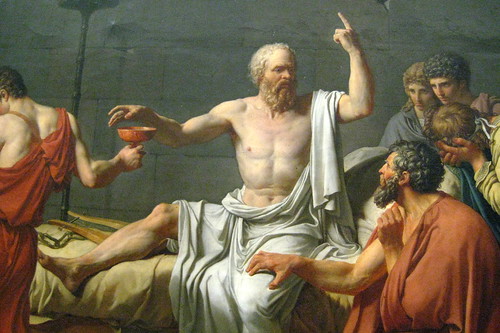
"An unexamined life is not worth living" - Socrates
A belief can be based upon faith but have evidence that supports it. For instance, the probability of my dying in a plane crash is very slim, thus I fly. However, because I can never ultimately know for sure if I'm not on an airplane that will crash, my belief is based upon faith. Even though it is a reasoned belief, reason doesn't obsolve it from being faith.
It is very convenient for the skeptic to divorce faith from reasoning. To do so, gives them a reason to not ask the ultimate question of religion's claims:
"Is it true?"
Before simply dismissing faith as man-made, I ask the skeptic to show me that he/she has examined religion's claims and has a good reason to reject them.
Simply claiming religion is man-made, without demonstrating evidence of such an examination, demonstrates prejudice, not a bold attempt to ask questions no matter where they might lead...
Tuesday, April 21, 2009
An Answer for Everything, Proves Nothing
Someone very dear to me has schizophrenia. He thinks that he's living the life of the Truman Show. He believes everyone in the world knows who he is and is watching his every move. He has an answer for everything.
I challenged his view one day by telling him that if he did a Google of his name, he'd be hard pressed to find himself even listed. I proposed that in a world where everyone is watching you and knows your name, a Google search was bound to prove this.
His explanation was simply that God could have manipulated the results of the Google search to hide the truth. We could all even be a part of a conspiracy. His answer was expected. "You have an answer for everything", I replied. The problem with his way of thinking is that there's nothing anyone can say or do to prove or disprove his beliefs.
He proves nothing by answering everything.
The brilliant scientist Stephen Hawking is very ill right now. He has spent much of his life working on a theory to unify Einstein's theory of relativity (which deals with physics on a large scale) with quantum theory (physics on a very small scale). His hope is that this unifying theory will explain everything.
I can't help but wonder, in the light of my schizophrenic friend, whether or not Hawking is looking for a system of truth that is just as insane.
Reading the doctrinal statements of some churches and Christian universities, I wonder if I don't see the same sort of insanity. They seem to have everything in life figured out. Is Christ anything if not a paradox? Does not the Christian see life in Christ's death, power in the cross, strength in His display of weakness and hope in His suffering?
I have always been skeptical of skepticism, but I am now becoming skeptical of any theory that claims to explain everything. I am starting to bring my skepticism of the "too good to be true" product that "slices and dices" to my philosophy.
Perhaps the best worldview of life purposefully leaves room for mystery. Perhaps the healthiest dogma is that which includes faith.
And why would the best worldview leave room for mystery if mystery wasn't the door for worship?
Thursday, April 2, 2009
I Want to Believe
“Do not seek the because - in love there is no because, no reason, no explanation, no solutions.” - Anias Nin.
As I encourage the questioning process, do I seek reasons in areas where there are none? Anias Nin, was no Christian, but she had a glimpse into the Christian concept of grace. Grace is NOTHING if it can be stood up on the legs of reason.
8For it is by grace you have been saved, through faith—and this not from yourselves, it is the gift of God— 9not by works, so that no one can boast" - Ephesians 2:8-9
I've been reading Pascal's Pensees lately. In it, he argues that there are some things that we know to be true that can't be proven via the reasoning process. Believing tomorrow will come is one example that I remember. Love is another.
I've always believed, against the grain, that faith and reason are supplementary as opposed to the common view that they are antithetical to each other. I've written about this in other postings and therefore won't repeat old ground.
However, in light of the nature of love and grace, I have to ask whether or not I go too far.
Perhaps the skeptics who think they have refuted religious faith, are standing on piles of mud that they have mistaken for gold. They think they have refuted faith by showing that there is no reason to hold it, but in doing so, they are really no different than the delusional person who might say that airplanes can't really fly because everything must be supported by the terrestrial. Perhaps their minds are too earthly. Or perhaps mine is too much in the clouds.
If airplanes operate by different rules when set in motion, despite the fact they are physically heavier than air, wouldn't God do the same?
Perhaps all that we call faith is really a test of our volition.
Perhaps what we believe (and even skepticism is belief) is really the naked exposure of our will.... our heart itself.
I was made for another. I am "otherly".
I want to believe...
Sunday, March 29, 2009
Why Faith?
If there is a God, have you ever asked “Why would He use faith as the channel to relate to Him?” Why wouldn’t he post a huge sign in the Cosmos that was not ignorable? For those of us on the earth, the Sun is a great example.
Imagine that you are extremely rich and famous. What a great dream! Now, imagine that you are searching for true love. How would you ever know if anyone really loved you for who YOU were vs simply loving all that comes along with your wealth and fame?
One way would be for you to hide who you really are.
You might hide your wealth and fame and search for someone who really loved you for who you were, not for what you have.
Christ hid His fame and fortune and came down to earth in a humble manger.
I often see God as someone who appears to be hiding. But He wants us to find Him. He also wants us to love Him for who He is and not because we have no choice.
If God appeared to us as a giant in the sky, we'd be stupid to not at least act like we loved Him.
So He seems to veil Himself in such a way as to give us a fork in the road. That fork gives us two interpretations of life. One is the materialist's worldview that says man is the arbiter of all things. Such a view might even allow for belief in a god, but he/she/it is impersonal (Deism).
The other option is a God that loves us, a God who cares about how we live our lives and wants those lives to be acts of worship.
I'm not here to tell you that one of the two interpretations makes more sense or is more rational than the other.
I'm asking you "Do you want to believe?"
Saturday, February 14, 2009
The Convergence of Faith and Reason
I am finding that a lot of people, religious as well as non-religious, seem to believe that faith and reason do not intersect. But if we just use reason alone, we will find that this assumption breaks down.
Mankind is finite. We are limited in what we know. We are limited in what we CAN know. For instance, there are things so far out in space, that no telescope or device will be able to observe, measure or detect. So reason alone says that there are things that exist outside of the reaches of empiricism.
I do understand that there are some people who have a rare philosophy that says that only that which we can observe and experience is real. Such a philosophy goes so far as to say that when a refrigerator door is shut, its contents cease to exist. There are many arguments against such a philosophy. I shall not expound on them, but only say that I think this philosophy says more about the limits of empiricism, than the limits of reality/truth.
So if we acknowledge that there are things that exist outside of our ability to observe and measure, than we have already seen a glimpse into the validity of faith.
But I can take faith even further. EVERYONE has faith. When you get in a car to go somewhere, can you absolutely 100% KNOW that you will arrive safely at your destination? Of course not. But do you BELIEVE you will arrive safely? If not, I don't think you'd get in the car in the first place. THAT is faith.
What if you were to get into the passenger seat of that car and let a drunk person drive you? That would be crazy wouldn't it? But do you absolutely KNOW that the drunk will have an accident? No, but the odds are against them driving safely. It is reasonable to conclude that you would be unsafe to ride with the drunk. But because you can't KNOW this for sure, you have faith. More specifically, you have a reasoned faith. You have a faith informed by rational thought. Your faith is informed by probability.
I could give many many more analogies that demonstrate this convergence of faith and reason. Every time we plan for the future, we "roll the dice" based on the probability that we will live for that future event. We have no proof so we have faith instead. That faith is backed up by reason. Interviewing for a job requires faith. But you wouldn't do it if you didn't have reason to believe you could get the position.
These examples are different than blind faith. Many religions do seem to advocate a blind faith. For instance, Hinduism and Buddhism claim reincarnation, but outside of some people's deja vu experiences, and subjective interpretations of nature, they don't offer any rational argument to support these claims. Most other religions have the same problem.
This is why I am a Christian. Christianity is different in this regard. Its cornerstone is the claim that Jesus Christ died and rose again. It could just make these claims (blind faith) and offer nothing more. Instead, it presents to us multiple witnesses to these claims who wrote the Gospels. These writers were so convinced of Christ's resurrection that they died for this belief.
Yes, it is true that many religious people die for their beliefs, but if you are thinking this, you have missed the point. These writers weren't just ANY group of religious people. They had the unique ability to validate their claims. All they had to do was go to the grave and see if Christ was there. All the Roman government had to do to stifle Christianity's threat to its empire was to produce Christ's body.
Why didn't this occur?
Yes, I have faith, but it is NOT a blind faith. It is a faith that is supported by reason. While I can't absolutely prove 100% these things, if I could it would NOT be faith. But because my faith is supported by a reasonable argument, it is not a blind faith.
What is your faith? Why do you believe it? If you merely believe in it because it makes you feel good, or out of fear, or because it serves you, you believe for the wrong reasons. And please don't think that I'm pointing a finger at you. These are questions that I ask myself.
There are other reasons that I believe as well. I will discuss those in my next two blogs.
If you've read this far and still do not see the convergence of faith and reason, I point you to Google on the subject of Christian Apologetics. Christian apologetics is an attempt by Christians to defend their faith using reason. If this convergence that I speak of does NOT exist, then neither would the apologist.
In every instance that I have EVER encountered someone who didn't understand this convergence, I have found that the dissenter was not aware of apologetics, or had not listened/read such arguments.
I close with this thought. If I were opposed to Christianity, wouldn't the most effective way for me to prevent its spread be for me to cast it as a faith that throws out the brain?
Socrates once said that the unexamined life is not worth living.
If I wanted to bury my head in the sand when it comes to questions regarding the meaning of life, the existence of God, how I should live my life, etc., would I find any better way to do this than to simply dismiss all religious people as holding to a blind faith?
Which takes MORE blind faith; to examine the reasons for believing or to simply dismiss them all as having blind faith?
Often our rejections of dogma, are dogmatic, our objections to zealotry are zealous, and our abstinence of intolerance is intolerant....
Subscribe to:
Posts (Atom)