Friday, November 27, 2009

Excavating Heads from the Sand


Be open minded, not so much that your brains fall out. When it comes to religion, so many so called "open minded" people seem to assume that religions only make claims that can NOT be tested. As a result of such thinking, they don't analyze religious claims, testing them to see if they might be true. Can you get more narrow-minded than that?

Sure, I can't claim every belief proclaimed by every religion is testable. For instance, when Islam claims that that the Koran is its only miracle in that it is divinely inspired, how do you test such a claim?

But on the other hand, when a religious worldview makes a claim on human nature, or makes a specific prediction of an event that has already passed, or on the nature of the universe, where such claims are testable, why should we bury our heads in the sand in the name of being "open-minded"?

Georg Wilhelm Friedrich Hegel gave us a system known as the dialectic that can basically be summarized as, postulate a thesis, test it against it's antithesis and come up with a synthesis. An example is in order:

Some worldviews claim that the universe is eternal. This is now testable. The Hubble satellite has found a red shift in the universe that indicates that the space is expanding. This is further confirmed by the fact that the farther we look out in space with a telescope, the closer stars and galaxies are clustered. If space is expanding, then it must have had a beginning.

Before the 1500's, the common worldview was that the heavens were unchanging. In 1572, supernovae were discovered. It would NOT be open-minded to say all worldviews are true therefore both sides of the space is or isn't changing are right. It would not be discerning to ignore the evidence that points in one direction. So why do many people treat religious claims differently?

Occam's razor is validated through the dialectic process. Occam's razor says do not multiply entities unnecessarily. In other words, Keep It Simple Stupid (KISS method). When Copernicus theorized that the celestial bodies were not orbiting around the Earth, it wasn't because of observation, but because of the simplicity of the model.

Later observation has confirmed Copernicus, further validating Occam's razor as a result.

Using the dialectic process, I can't believe in Hinduism because it claims the existence of millions of Deities, thus violating Occam's razor of not multiplying entities (Deities) unnecessarily.

Although, I have the most respect for it, I reject Buddhism because it's answer to man's suffering is to make man essentially numb by prescribing that we rid of ourselves of all attachments. Medical science can do this by medicating someone into a vegetative state. If you think that is too extreme of an example, I have watched a close family member medicated with antipsychotic medications that took away this person's "attachments" and made them lethargic and carefree.

I reject Islam because it says kill infidel. Faith can never be coerced or imposed. BTW, I don't claim every Muslim to be such an extremist, but I would suggest that a moderate Muslim is contradicting the Koran which they try to live by.

However Judeo-Christianity makes some testable claims that I can't find a fault in. It has been saying that the universe is "spread like a tent" in over ten places within the Bible.

Judeo-Christianity teaches that there is one God, although I admit that the concept of the trinity is a threat to complying to Occam's razor.

Despite the historical exceptions where people in the name of Christ have killed others in crusades and inquisitions, the actual teachings of Christ are clear that the Gospel is to be spread through persuasion (preaching) and NEVER through such means.

And what Judeo-Christianity says about human nature is probably most profound and easiest to validate. It claims that man's nature is bent towards selfishness. Among so many other things, it also validates our human right to own possessions thru one of the ten commandments stating "Thou shall not steal."

The success of nations with capitalist economies validates this combination. Capitalism. Unlike other economic systems, which either try to make everyone equal in what they own, or where the Government owns everything, modern history gives us an undeniable truth that an economic system that capitalizes on man's selfishness, turning it into a means for him to serve others for gain, yields the most success. BTW, I don't claim capitalism is perfect.

It has been said that the world would be perfect if it weren't for people. 90% of the evil that occurs in the world is not the result of natural disasters or sickness. Most of the suffering that occurs in the world the result of the selfishness and lack of restraint of others.

This lack of restraint can sometimes only be justified by altruism. Altruism only makes sense if there's a God who is always looking even when others are not. When we CAN get away with committing a selfish act, dishonest gain, etc., the only reason we can come up with to walk the straight and narrow is if there is a God who keeps score.

I've quoted it before, but it bears repeating. Cardinal Emmanuel Suhard once said:

"To be a witness does not consist in engaging in propaganda, nor even in
stirring people up, but in being a living mystery. It means to live in
such a way that one s life would not make sense if God did not exist."

Life without altruistic behavior would be unlivable, so why wouldn't a life lived without God be the same?

Wednesday, November 25, 2009

Lambert Controversy is about purpose NOT expression


The latest Adam Lambert controversy at the AMA music awards (see http://www.nydailynews.com/gossip/2009/11/23/2009-11-23__adam_lambert_delivers_raunchy_ama_performance_filled_with_hip_thrusts_crotch_gr.html) gives the illusion of being about censorship, but make no mistake, this is really about purpose and meaning.

After the show, Lambert hailed his shocking performance as freedom of expression. But if one were to ask Lambert if it would have been acceptable to have paraded children in provacative poses, I'm not so sure he would have defended such expression. And I'm certain that if a Christian entertainer would have performed at the awards and made explicit expressions of worship, statements on the sanctity of unborn life, or statements about God making a man for a woman, he wouldn't have defended these in the name of expression.

As I proceed, please don't get me wrong. Except for the expressions of worship, I don't think the Christian entertainer in my hypothetical would be wise in going this route. I'm only pointing out that this is NOT about freedom of expression. This is about what people call "values".

With that said, I don't like to use the term values, because I feel that it is a term that has been hijacked. It is a term that people say without really thinking about what it might mean. I will therefore frame the concept differently.

One more disclaimer. I'm not one of those Christians who acts like homosexuality is underlined and highlighted in Christian teaching as the greatest sin. Furthermore, I believe in treating such people with compassion and would NEVER advocate violence or even a judgmental attitude expressed towards them.

I can't speak on the specifics of Lambert's worldview, but he obviously doesn't believe that homosexuality is immoral, nor does he seem to hold a high standard for heterosexual expressions.

On the other side, to simply object to Lambert's antics as being immoral fails to get to the heart of the issue. I believe that life has a purpose. That purpose is given by a God. That God has an intention for our relationships. Lust in any form violates that purpose. This is akin to someone desecrating a cemetery (see http://www.msnbc.msn.com/id/31832393/). Should such actions be defended as freedom of expression?

Why would this appall us? In the story, the employees desecrated the cemetery to free up plots so that they could resell them. They were out to make a $. This is where their "values" lie.

The reason a cemetery desecration appalls us is because inherently, we know that life has a purpose.

I'm not mad at people like Lambert. I feel sorry for them. They live the same purposeless lives we've seen Elvis Presley, Michael Jackson, and others live before them. They aren't happy people because they have been willing to sacrifice purpose for their own lusts. They have exchanged the joy of life for a bed. Unfortunately, they will have to lie in it.

Monday, September 28, 2009

God Outside The Box


Do atheists disbelieve in God because of a lack of evidence, or simply because the evidence suggests a God that doesn't fit within our natural human expectations?

I suspect the latter, more than the former.

I was in awe of the eastern sky this morning. As the sun set low in the sky, it was hidden behind a mist of clouds exuding hues of blues, pinks and yellows. The imagery inspired a sense of mystery and awe.

My scientific mind would expect a God who can be detected, hence placed under a microscope and observed, measured, predicted and reduced to a set of laws.

This world we live in with its suffering and death, coupled with its beauty and order, suggests that if a God exists, God transcends our imaginations...

Are you willing to believe in a God who is outside of your box?

Monday, September 21, 2009

Why do we ask questions?


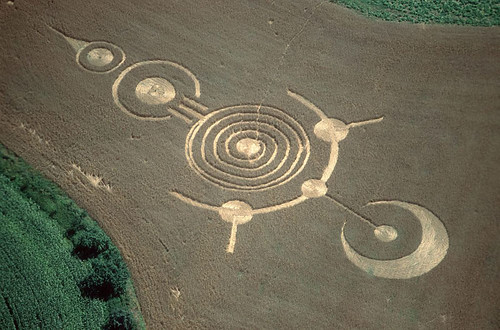
A coworker of mine pulled up www.google.com one morning and noticed today Google had their logo branded as a crop circle. His first reaction was to put up his hands and ask if today was national crop circle day.

Everyone asks questions about life. Why do we ask questions? Is it not because we are driven by coherence? Are we not wired to make sense of the world? Why would this be? Why are we so hungry for meaning and purpose in life?

WHO's purpose are we hungry for? Maybe you've never thought of this question before, but how can purpose exist independent of a being that actually has a will?

We can speak about the purpose of a chair being for people to sit in. As a result, even though practically a chair can function as a table or as a step ladder, we all seem to know that anyone who uses a chair in such a manner is not making the most of the chair's ultimate purpose. This is certainly not the intention of chair designer/manufacturers.

OTOH, some art is created with a different philosophical approach. We've all seen the type of art that causes us to ask, "What is it supposed to be?" The artist's answer can usually be summed up to be "It is what it is. It is supposed to be what you see and nothing more." I believe such artists are trying to escape this questioning process that is inherent within our very human nature. The artist might try this because so many of life's questions are unanswerable. But they won't be able to escape the average observer from asking such questions. Why is this?

Saturday, September 19, 2009

Standing at the crossroads of life


In a post entitled, "The Power Of Volition" borrowing from Ravi Zacharias, I wrote about 4 tests for truth:

1. The establishment of objectivity
2. The test of empirical adequacy
3. The test of logical consistency
4. The test of experiential relevance

An astute animal rights activist can defend vegetarianism and meet all of the above criteria with the same skill that a meat eater can.

The vegetarian, believing that we evolved from monkeys as their presupposition, demonstrates a logically consistent argument in concluding that we shouldn't eat meat as a result. They even draw a sense of higher purpose as a result of practicing vegetarianism.

As for empirical adequacy, they might point to the facts as they interpret them in the forms of fossils, carbon dating, etc...

The meat eater can make just as valid of an argument, also meeting the above criteria. Pointing to the fact that humans have teeth that are naturally designed for tearing out flesh, they can logically conclude that the human species was designed to eat meat. By advocating a form of creationism that concludes that there is a separation between the Creator and creation, they logically conclude that man has been specially set apart from the animals.

They also point to thefacts in the forms of fossils, carbon dating, etc., but interpret them in a way that supports THEIR arguments.

I once heard a young earth creationist state that both an evolutionist and a creationist look at the same facts of the Grand Canyon, one saying, "A lot of time and a little water", while the other says, "A lot of water (Noah's flood) and a little time" formed it.

In the end, life seems to present to us forks in the road. In our scientific age, we seem to believe that all of these forks are answered via the empirical process, however empiricism only answers the surface questions.

The deepest questions of life are never answered, they are chosen. Life forces us to choose. It as if life is testing our hearts.

Why would the universe care? It doesn't? But there is a God behind the universe that does care?

Love is a choice. What do you choose when standing at the crossroads?

The universe posed as one giant question


The universe is a mystery. We look up at the cosmos and see balls of energy in the form of stars and planets, swirling around in what seems to be ordered chaos (not unlike jazz music).

Many people see this to be evidence that life as we know it came about by random chance processes. In such a world where chaos is natural, why is it that our human nature tries to see the order in life?

"If you are really a product of a materialistic universe, how is it that you don't feel at home there?"
--C.S. Lewis, "Encounter with Light"

If nature has produced us by random processes and chance, then why does this bother us?

Is the universe really silent because we live in a cold and impersonal world, or is it the silence of a library which allows one to best study its contents?

Thursday, September 17, 2009

Faith Directions: To have faith, believe here.


I have made the case for faith in "The World Screams Faith" as well as other blogs. But this just begs the question, "What shall I have faith in?"

This world that screams faith, imposes faith decisions on us every day. Whenever we get into a car to drive to a destination, do we absolutely know with 100% certainty that we will arrive at our destination safely? I just passed a fatal car accident yesterday where thd driver's van was turned upside down.

Like that driver, we cannot absolutely KNOW anything, much less whether or not we will arrive safely at a destination. Now, would you get in the passenger seat of a car, put your seat belt on and let a totally inebriated driver take the wheel for the next 30 minutes on a busy interstate?

What's the difference between these two scenarios? Is it not found in the probability of you reaching your destination safely? Is it not found in the amount of reasoning you are able to apply given each scenario? Since theoretically your fate could swing either way, your choice is based ultimately on faith.

I advocate a rational faith. A faith that takes in the facts and boldly asks all the possible questions, willing to go wherever those questions might lead.

Someone has said that capitalism is the worst economic system in the world except when compared to all other economic systems in the world.

It is a fantastic leap of faith for me to believe in all that Christianity stands for, but it is a ludicrous leap of faith for me to reject it.

I believe in the testimony of the 40 authors who wrote the 66 books of the Bible, spanning over 1000's of years and crossing many cultural boundaries. I don't hold this faith because I can prove it. I hold this fantastic faith because rejecting it is impossible when considering the facts.

Skeptics who claim that its claims are fictious fail to give an alternative explanation that requires less faith than the Christian faith to which I hold.

The strongest and most common criticism they levy is the claim that the New Testament (N.T.) was written by people in high powers of Government throughout history in order to control the masses, gaining money and power through belief.

We believers stand in awe of common themes that exist between the O.T. and N.T.

My favorite one is to simply compare John 3:16 with Genesis 22:

John 3:16, the most famous verse in the Bible, says, "For God so loved the world, that He gave His only son so that whoever believes in Him will have eternal life."

This scripture is a one verse summary not only of the Gospels as they unfold their story in the N.T., but also of the O.T. story of Abraham offering His only son Isaac as a sacrifice in Genesis 22.

But the skeptic believes this coherence was manufactured. They believe that the four Gospel writers collaborated and wrote their accounts to purposefully mirror the O.T.

These same skeptics will point out the differences in various Gospel accounts. Yet, if the four Gospels are the result of a collaborative scheme, why would the authors give varying accounts of some stories? Why would they disagree on some details?

And none of this explains the motives and veracity of the O.T.

A plausible alternative explanation has not been offered by the skeptic. It takes great faith to accept Christianity, and a greater faith to reject it.

Given the volitional nature of faith established in previous blog postings in the Pendulum Effect, life (or as I believe God) asks us the question, "What do you WANT to believe?" Such a question tests our heart's desire and tells us what WE are, not what this world is. The telescope that we try to aim outwardly, has turned inward becoming a microscope. What starts out as an attempt to search outer space, becomes a discovery of "inner space".

What were you made for? Does your heart scream "ME, ME, ME!", or does is beg to serve someone greater?